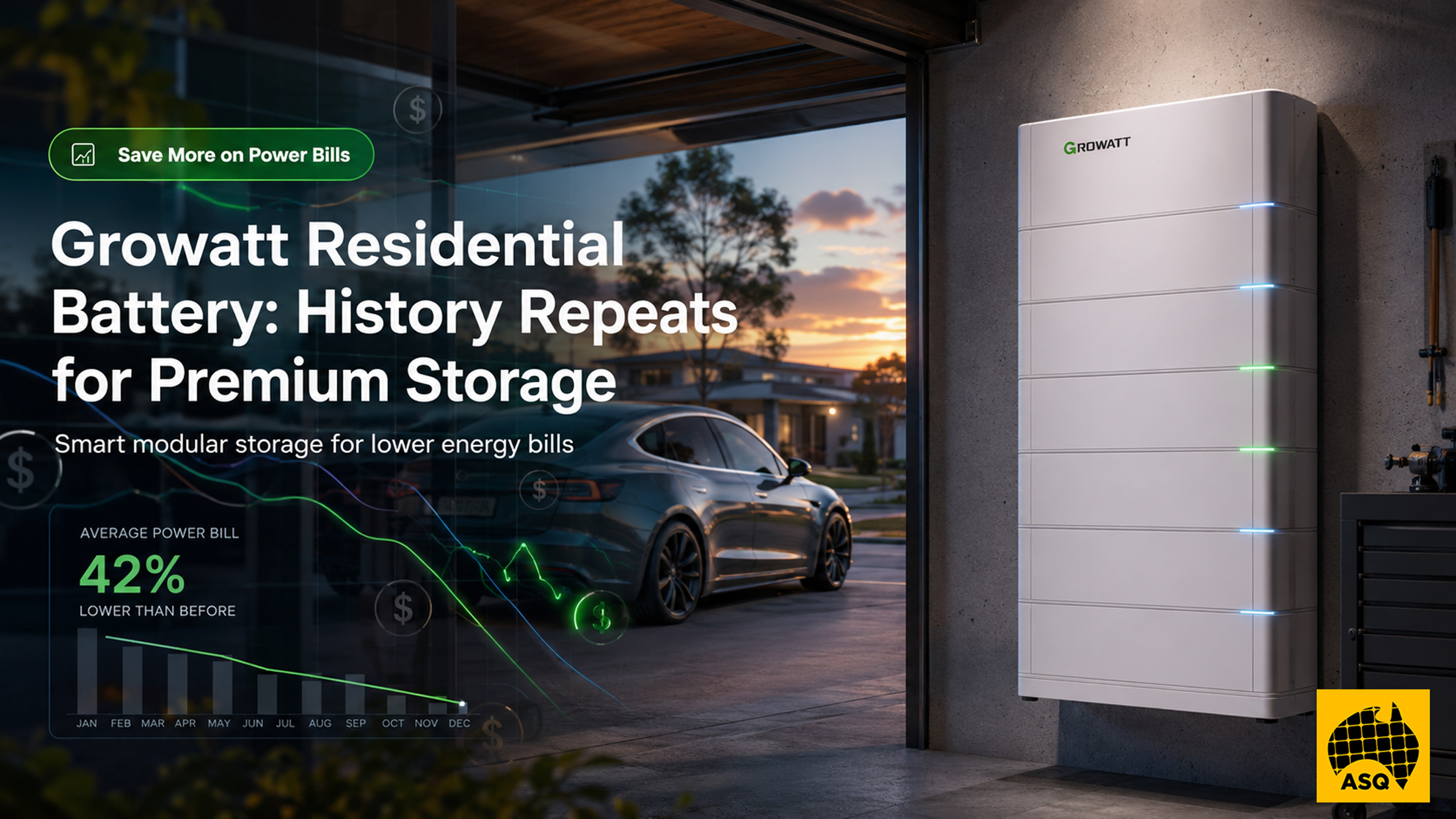
Walk across the concrete floor of any major Australian solar distribution hub in May 2026, and the sensory signature of the energy transition hits you immediately. The metallic tang of unboxed aluminum racking has been replaced by the subtle, continuous hum of active battery management systems under test. Pallets of standard domestic grid-tied inverters are increasingly pushed to the back walls, making way for towering stacks of lithium iron phosphate (LFP) modules. There is an unspoken urgency among the warehouse staff loading delivery vehicles; the systems they are handling are no longer simple daytime solar additions. They are complex, heavy, multi-kilowatt-hour storage assets bound for an domestic grid that has grown structurally hostile to unbuffered solar export.
According to the groundbreaking data released in the SunWiz Australian Battery Market Report 2026, the domestic energy storage sector underwent a spectacular, hyper-accelerated transformation over the past twelve months. A record-breaking 221,000 residential battery systems were deployed across the nation, representing a staggering threefold increase in system count and a fivefold explosion in total installed capacity compared to the previous registration period. Driven by the mass implementation of the federal Cheaper Home Batteries Program, energy storage has decisively transitioned out of the early adopter niche and into the mainstream industrial complex.
This massive volume surge has permanently altered what everyday Australians buy, how systems are designed, and which manufacturing brands hold the balance of power. For the independent solar contractor and retail business operator, the massive scale of 2026 has initiated a critical sales confrontation. The core battleground for installer margin no longer rests on convincing a consumer to adopt storage; it rests on navigating the intense feature convergence between value-driven industrial giants and luxury hardware providers. As contractors audit their product portfolios to capture this unprecedented wave of volume, the debate inevitably focuses on a defining competitive benchmark: the performance capability of a Growatt residential battery vs premium brands.
The Collapse of the Legacy Prestige Premium
The Australian distributed energy market has processed this exact Darwinian restructuring once before. In the early sequence of the rooftop solar boom, the industry was strictly bifurcated by an unspoken “prestige tax.” Elite European inverter brands commanded significant margin premiums based on their self-contained engineering ecosystems, advanced data monitoring, and perceived immunity to thermal breakdown. Early installation firms willingly paid this premium because entry-level hardware alternatives lacked basic survivability under the harsh local UV and ambient thermal conditions.
However, an industrial transition occurred. High-volume manufacturers aggressively re-invested global capital into sophisticated automated manufacturing lines, multi-MPPT tracking innovations, and robust outdoor-rated cooling topologies. Within a brief multi-year window, features that previously defined the ultra-luxury tier became baseline, mass-produced industry standards. The prestige tax collapsed, forcing several legacy European players into market consolidation or outright insolvency. The surviving entities were not those that relied on heritage branding, but those that scaled high hardware resilience at a highly competitive cost-per-watt.
In 2026, the home energy storage market is navigating an identical inflection point. For years, premium tier-one providers maintained market dominance by enforcing a conservative operational envelope—often artificially limiting a battery’s Depth of Discharge (DoD) to 80% or 85% to preserve sensitive, passively cooled cells. In the current grid environment, this hidden capacity tax is no longer commercially viable. With midday wholesale electricity spot prices regularly plunging into negative territory across the National Electricity Market (NEM), home storage systems must execute aggressive, unrestricted daily deep-cycling routines to insulate consumers from soaring network demand tariffs. The luxury boundary has worn thin, exposed by mass-produced hardware that delivers commercial-grade specifications directly to domestic properties.
True Usable Capacity (Active Yield)
Dead Capital Asset (Locked Capacity)
The Usable Capacity Gap: Value on a 15 kWh Nominal System
(95% DoD)
(90% DoD)
(80% DoD)
Growatt Residential Battery vs Premium Brands
To accurately evaluate the competitive landscape of a Growatt residential battery vs premium brands, solar enterprise owners must move past marketing slogans and examine the raw engineering metrics defining the 2026 product lines. Historically, luxury brands like Tesla (with Powerwall 3), Enphase (IQ Battery 5P), and the rapidly ascending market leader Sigenergy justified their high entry costs by claiming a monopoly on software intelligence, modular safety, and installation speed.
However, the rapid deployment of commercial-grade technical architectures into the domestic product lines of volume manufacturers has completely disrupted this defensive position. When analyzing the current technical realities, the engineering gap has narrowed to a razor-thin margin:
- Uncompromised Depth of Discharge Performance: While certain premium brands continue to restrict their operational parameters to shield uncooled cell architectures, volume leaders have normalized a 95% to 100% true Depth of Discharge across their modular residential lineups. The deployment of high-density Lithium Iron Phosphate (LFP) chemistry across next-generation systems like the Growatt APX series and highly configurable Deye modular batteries ensures that the usable capacity matches the nominal face-value of the asset. This engineering maturity eliminates the legacy sales objection where premium consultants could point to a value brand’s restricted capacity buffer to justify a luxury brand upgrade.
- Commercial-Grade Thermal Integration: Passive convection and simple internal heat sinks are proving insufficient as suburban Australia encounters increasingly volatile summer temperature spikes. Pushing a domestic battery through rapid charge and discharge cycles during a peak grid event requires sophisticated thermal control. Volume platforms have responded by migrating heavy industrial cell protection downward, utilizing advanced multi-point thermal monitoring systems that limit internal cell temperature variances to under 3°C, matching the environmental resilience of specialized premium enclosures.
- Massive Domestic Scaling Vectors: The traditional residential installation paradigm assumed a fixed, conservative consumption model—typically capping home storage configurations between 10 kWh and 15 kWh. The all-electric home mandates of 2026, coupled with multi-car electric vehicle (EV) charging requirements, have made these legacy capacities insufficient. Growatt’s 2026 product roadmap directly counters premium capacity limits through the parallel functionality of MIN Hybrid Inverters, allowing residential installers to build domestic micro-grids scaling up to an unprecedented 45.6 kW of continuous output paired with 120 kWh of battery storage capacity.
Sizing Sweet Spots and Regulatory Constraints
The sudden realignment of the Growatt residential battery vs premium brands landscape is not occurring in a legislative vacuum. The parameters of Australia’s decentralized energy transition are strictly governed by state and federal subsidy guidelines. The Federal Government’s Cheaper Home Batteries Program completely reshaped the economics of home storage deployment. By structuring the financial incentives to peak heavily for systems at 14 kWh and below, the policy rewards precise modular system sizing.
This specific tiering creates immediate friction for monolithic, single-block battery architectures. A product that forces a customer into a rigid, non-modular 13.5 kWh block cannot scale incrementally if the homeowner’s electrification requirements expand twelve months later. Conversely, modular, stacked architectures—which utilize independent 5 kWh or 7 kWh battery blocks—allow an installation firm to design a system that hits the absolute pinnacle of the federal subsidy profile. If the client’s consumption expands, the installer can return to site and append an additional storage module to the existing stack in under thirty minutes, protecting the consumer’s initial capital expenditure.
Simultaneously, Distributed Network Service Providers (DNSPs) across Australia have tightened grid-interconnect compliance frameworks. Under revised AS/NZS 4777.2:2020 guidelines, network operators enforce strict capacity rules. While streamlined, automated approvals are maintained for aggregate inverter capacities up to 30 kVA on balanced three-phase commercial and light industrial properties, residential single-phase properties face tight 5 kVA to 10 kVA limitations per phase, frequently tied to strict zero-export mandates during peak daylight hours.
Consequently, the modern solar contractor cannot solve energy shortages by stacking multiple large, single-phase luxury inverters across a domestic property. They require highly integrated, multi-phase hybrid inverter platforms equipped with smart export limiting software to keep the property fully compliant with local grid rules while maximizing the site’s self-consumption profile.
The Darwinian Reshuffling of the Australian Battery Leaderboard
The convergence of high-spec utility technology and residential hardware has resulted in a radical, unprecedented restructuring of manufacturer market share across Australia. The independent retail statistics compiled by SunWiz outline a market where historical brand loyalty has collapsed in favor of immediate modular value and verified installer convenience.
2026 Australian Residential Battery Market Share Leaderboard
The most notable development in the 2026 market report is the meteoric rise of Sigenergy, which officially claimed the Number 1 battery manufacturer position in Australia by blended capacity, capturing a dominant 17.4% market share. Sigenergy achieved this position in less than two years by deploying their flagship SigenStor system—a comprehensive “5-in-1” stackable tower that integrates solar generation, storage, advanced backup switching, DC EV charging, and an AI-driven energy management architecture into a single physical unit. Installers have adopted the platform because it slashes commissioning times down to under an hour while addressing the consumer’s long-term home electrification roadmap.
Following closely in a tight race for the volume crown is utility giant Sungrow at 17.1% market share, sweeping the 2026 SunWiz Top Solar Companies Awards across both the residential inverter and commercial energy storage categories. AlphaESS maintains a firm grip on the third position at 15.2%, dominating the cost-sensitive, high-volume retail sectors.
In stark contrast, Tesla’s Powerwall has drifted backward to fourth place in overall capacity market share. While the Powerwall 3 retains immense, undisputed consumer brand equity, its non-modular architectural format creates ongoing sales friction for contractors attempting to build custom-capacity systems that align with specific customer budget constraints or federal subsidy limits.
The most profound warning to the premium establishment, however, is the complete market displacement of LG Energy Solution. Once an absolute titan of the Australian residential battery market alongside Tesla, LG’s market share has severely contracted following an extensive, multi-year product safety recall affecting over 18,000 RESU batteries manufactured between 2016 and 2019. The Australian Competition and Consumer Commission (ACCC) issued multiple severe warnings and enforced extended undertakings after fifteen recorded thermal runaway incidents resulted in significant property damage across Australia, including the complete destruction of a residential home in Victoria.
This safety failure shattered installer confidence. Concerned with corporate liability, consumer safety, and licensing integrity, the national installer network rapidly abandoned the legacy incumbent, creating a massive market vacuum that stable, value-driven Lithium Iron Phosphate (LFP) manufacturers immediately captured.
The rapid decline of historically secure luxury incumbents proves that brand prestige provides zero insulation against engineering stagnation or safety failures. The independent installer network controls the distribution channel, and they are overwhelmingly selecting platforms that combine rapid, automated commissioning with uncompromised physical cell safety.
— Warwick Johnston, Managing Director, SunWiz (Analysis of the 2026 Storage Transition)
Native VPP Infrastructure vs Walled Gardens
The final battleground determining the outcome of the Growatt residential battery vs premium brands conflict has moved entirely away from physical sheet-metal enclosures and into the realm of cloud-based asset orchestration. Historically, luxury brands maintained their market premium by offering superior, consumer-facing software. They constructed highly polished, proprietary walled gardens that locked consumers into specific retail energy networks or specific Virtual Power Plant (VPP) aggregators.
In 2026, that software monopoly has officially ended. High-volume manufacturers have recognized that uncoordinated hardware is an endangered species in a highly volatile grid. The rollout of Growatt’s brand-new SHINER commissioning and monitoring platform represents a direct challenge to the user-interface hegemony of luxury brands.
More importantly, the integration of native Virtual Power Plant (VPP) utility trading services across their hybrid product lineup fundamentally shifts the consumer value proposition. Homeowners are no longer required to pay a steep luxury brand premium simply to access the financial benefits of localized energy trading.
Through mass-produced, commercial-grade domestic controllers, everyday households can automatically execute automated grid arbitrage routines. The system actively monitors real-time NEM pricing data—instantly charging the LFP cells when daytime rooftop solar saturation drives local feed-in tariffs into negative zones, and rapidly discharging stored energy back into the network during lucrative, multi-thousand-dollar evening peak grid stress events. The home battery is no longer a passive, backup appliance; it operates as an active, automated financial asset designed to minimize the property’s total energy expenditure.
Why the Shifts Are Happening in 2026
The data from the latest SunWiz 2026 Australian Battery Market Report outlines three structural shifts dictating who wins and who dies in this market:
The absolute takeaway for an installation business in 2026 is that brand loyalty is dead, and modular efficiency is everything. The collapse of LG Energy Solution proved that safety and installer trust are fragile, while the rapid rise of Sigenergy proves that the installer network dictates who wins. If a brand cannot make an installation faster, safer, and highly scalable for the customer’s growing electrification needs, it will not survive the multi-year battery boom.
Trend Driving the Market
Strategic Winner
Strategic Loser
The “Installer Availability” Bottleneck
Winner
Brands with plug-and-play stacking that reduce install times down to under an hour (Sigenergy, AlphaESS).
Loser
Complex setups requiring heavy wall reinforcement, external terminal boxes, and tedious wiring.
Grid Volatility & Midday Solar Slump
Winner
Systems with native VPP trading software and high maximum charge/discharge rates to capture rapid frequency trading.
Loser
“Dumb” batteries that only execute basic, passive household self-consumption routines.
Subsidy Sweet Spots
Winner
Modular units that can be precisely configured to hit the exact 14kWh peak tier of the Cheaper Home Batteries Program.
Loser
Fixed-capacity systems that force customers into sub-optimal sizing tiers.
Strategic Summary for the Solar Enterprise
Adapting Your solar companies strategy to the High-Spec Value Era
The rapid commercialization of the residential energy storage market is an explicit warning that the operational models of the past five years are no longer viable. If your solar enterprise is still attempting to secure consumer contracts by relying on lifestyle brand status or simple aesthetic appeal, your sales pipeline is highly vulnerable to more agile, technically grounded competitors.
To maintain market relevance and protect corporate margins within this hyper-competitive landscape, Australian solar business owners must implement three clear strategic changes immediately:
- Deconstruct the Premium Narrative with Data: Train your consulting teams to move past legacy brand bias. Force them to present transparent, rigorous financial proposals to prospective clients based on true usable throughput per dollar. If an ultra-luxury brand charges a 35% cost premium while delivering an identical or inferior modular footprint compared to an advanced value platform, your sales team must have the analytical clarity to prove that variance on the design table before an aggressive competitor undercuts your operation.
- Master Commercial-Scale Residential Topologies: Stop treating domestic battery projects as simple, single-cabinet installations. As Australian homes undergo comprehensive electrification—deploying dual electric vehicle charging stations, heavy induction heating configurations, and massive electric heat pumps—your technical teams must be fully certified to engineer high-voltage, multi-unit parallel hybrid setups. Ensure your field installers can deploy advanced three-phase configurations that seamlessly comply with local DNSP capacity limits.
- Monetize the Grid Arbitrage Envelope: Shift your consumer marketing strategy away from basic blackout protection scenarios. Frame the entire home energy storage discussion around active asset management and automated grid interaction. Utilize advanced, next-generation monitoring frameworks like the SHINER platform to demonstrate to consumers exactly how a high-DoD, value-driven storage asset can autonomously ingest low-cost daytime power, insulate the home from peak retail charges, and actively generate revenue through automated VPP dispatch.
The era of selling residential solar storage as an aesthetic consumer luxury appliance is dead. As grid dynamics grow increasingly volatile and state sub-programs reward strict capital efficiency, market dominance belongs entirely to solar enterprises that can deliver verified commercial-grade performance at a highly accessible price point. The industrial trickle-down has redefined the suburban grid—and it is time to realign your business model to exploit it.
1. SunWiz – Australian Battery Market Report 2026References
2. Clean Energy Regulator – (SRES) Battery & Inverter Compliance Registry 2026.
3. ACCC – LG Energy Solution RESU Battery National Safety Recall
4. AEMO – 2026 National Electricity Market (NEM) (DER) Integration Analysis.
5. Growatt Australia – Technical Operations Manual (Q2 2026 Release).