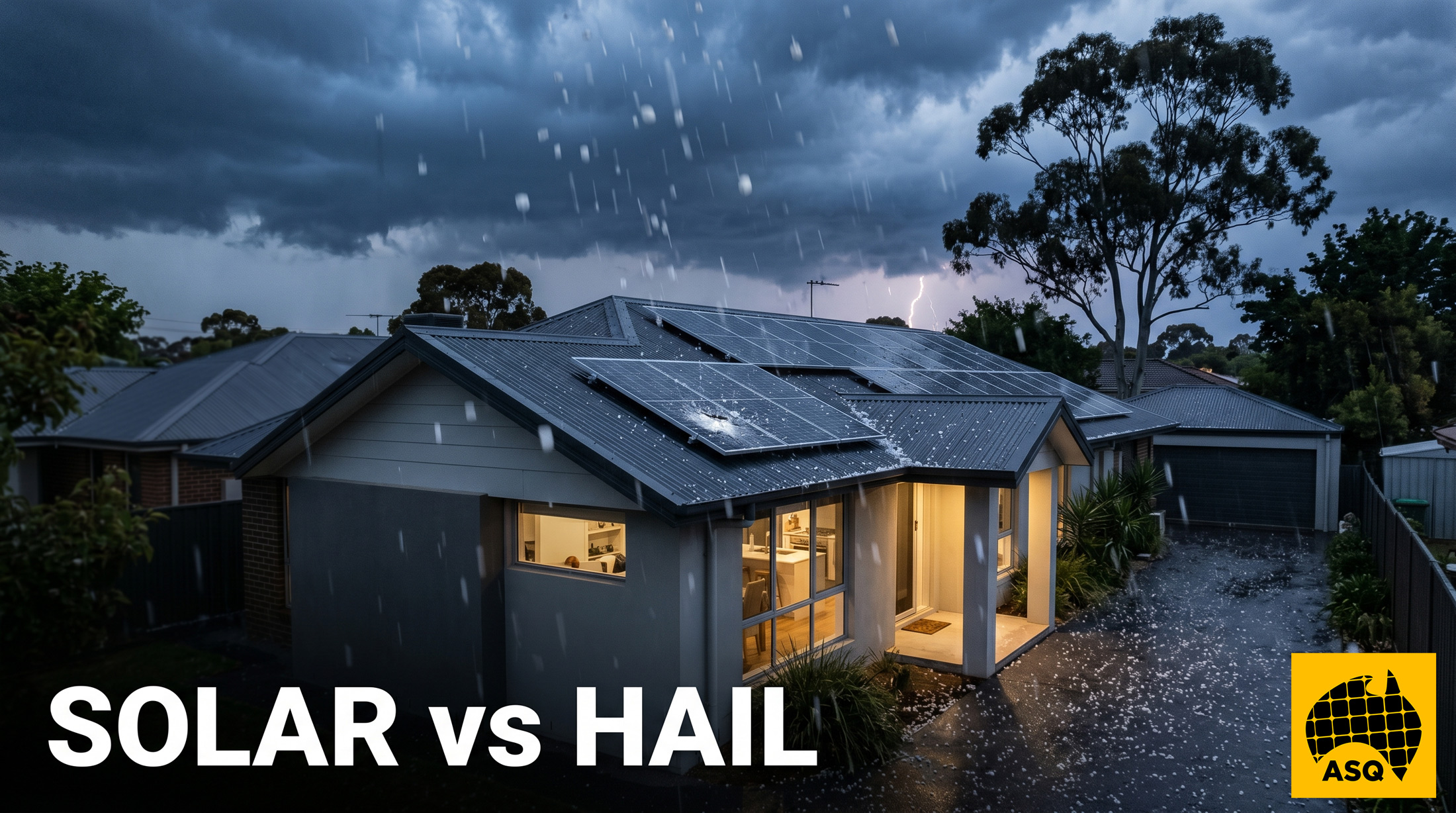
Rooftop Solar Panels vs Australian Hailstorms
Australia is no stranger to wild weather. From summer supercells in Queensland to destructive hailstorms across New South Wales, Victoria and South Australia, severe storms are a real concern for homeowners with rooftop solar.
So, it is fair to ask: can solar panels survive hail?
The short answer is yes — quality solar panels are built and tested to withstand hail. But that does not mean they are indestructible. Large hail, repeated impacts, poor-quality panels, incorrect installation, older glass, existing microcracks and extreme storm conditions can all affect how well a rooftop solar system holds up.
For Australian homeowners, the smart approach is not to look for “hail-proof” solar panels. It is to choose high-quality, standards-compliant solar panels, have them installed correctly, understand your insurance cover, and know what to do after a major storm.
A Real-World Hail Test: NREL’s 2017 Colorado Storm
One of the most widely cited examples of solar panel hail resistance comes from the National Renewable Energy Laboratory, or NREL, in Golden, Colorado.
In May 2017, a severe hailstorm hit the Denver area, producing hailstones reported at up to 2.75 inches, or about 7 cm, in diameter. Cars, buildings and other infrastructure were badly damaged. Yet NREL later reported that only one solar panel was broken out of more than 3,000 panels on or near its Research Support Facility.
That is a strong real-world example of how resilient solar panels can be when they are well-made and properly installed.
But it is also important to keep the lesson in perspective. The NREL storm does not prove that every solar panel will survive every hailstorm. It shows that quality solar panels can perform extremely well in severe weather — but performance depends on the panel, the installation, the hail size, the impact angle and the condition of the system.
TUV America states that:
The test equipment is a unique launcher capable of propelling various weights of ice balls at the specified velocities so as to hit the module at 11 specified impact locations +/- 10mm distance variation. The time between the removal of the ice ball from the cold storage container and impact on the module shall not exceed 60s.
The video below illustrates a “quick and dirty” experiment with high-pressured pneumatic cannon full of ice, metal and plastic balls.
APVI says that:
“Hail testing is mandatory under Australian and international PV standards. IEC 61215 and IEC 61645 for crystalline and thin film modules respectively require modules to survive 25mm diameter ice balls fired at 23m/s on 11 points across the module for the Moderate Hail Test (Class MH) or 75mm under the Severe Hail Damage Resistance Test (Class SH) (TUV Rheinland 2009).”
Are Solar Panels Hail Proof?
No solar panel should honestly be described as completely hail proof.
Most good-quality panels are hail resistant, not hail proof. That means they are designed and tested to withstand a defined level of hail impact under laboratory conditions.
In Australia, solar panels used in new STC-eligible installations must meet modern product standards, including IEC 61215:2021. The Clean Energy Council says that from 1 April 2025, new solar installations must use modules meeting IEC 61215:2021 to be eligible for Small-scale Technology Certificates, or STCs.
The Clean Energy Regulator also runs a solar panel testing program to help ensure panels meet Australian standards and remain eligible under the Small-scale Renewable Energy Scheme.
How Solar Panels Are Tested for Hail
The standard hail impact test under IEC 61215 is commonly described as firing 25 mm ice balls at the module at around 23 m/s, or roughly 83 km/h, at multiple impact points across the panel. These impact points can include vulnerable areas such as corners, the frame area and the centre of cells.
This test is useful, but homeowners need to understand what it does — and does not — prove.
A panel that passes standard hail testing has met a minimum recognised durability benchmark. It does not mean the panel will survive a direct hit from 8 cm, 10 cm or 16 cm hail. It also does not guarantee there will be no hidden cell damage after a major storm.
Some manufacturers test beyond the minimum standard, with larger ice balls, higher impact speeds or additional mechanical load testing. If you live in a hail-prone area, that is worth asking about before buying a system.
Why Australian Hail Is a Serious Solar Consideration
Australian hailstorms can be severe. The Bureau of Meteorology keeps a national Severe Storms Archive that includes recorded hail events across Australia dating back to the 18th century.
Queensland has seen some particularly extreme examples. In October 2021, giant hailstones in excess of 16 cm were reported near Yalboroo, north of Mackay, with ABC reporting that the Bureau of Meteorology described them as Australian record-sized hailstones.
That sort of hail is well beyond the standard 25 mm laboratory hail test. In a storm like that, even high-quality panels, skylights, roof tiles, vehicles and outdoor structures can be damaged.
This is why solar buyers should think beyond the sales brochure. Hail resistance is one part of a bigger decision that includes product quality, warranty support, installer experience, roof design and insurance.
What Makes a Solar Panel More Hail Resistant?
Several factors can influence how well a solar panel handles hail.
The first is the quality of the front glass. Most solar panels use tempered glass, often around 3.2 mm thick, although the exact design varies between manufacturers and panel types. Tempered glass is designed to be stronger than ordinary glass and, if it fails, it typically breaks into small pieces rather than long sharp shards.
The second factor is the frame and module construction. A strong frame helps support the glass and reduce flexing under impact. Poorly framed or lower-quality panels may be more vulnerable to stress, especially around edges and corners.
The third factor is installation quality. Correct clamp zones, rail spacing, roof fixing, tilt and cable management all matter. A panel installed outside the manufacturer’s specifications may be more likely to suffer damage, and it may also create warranty problems.
The fourth factor is existing wear and tear. Older panels, panels with microcracks, previous storm damage or poor handling during installation may be less resilient when the next storm hits.
Finally, there is the hail itself. Size matters, but so do density, wind speed, impact angle, storm duration and whether hail strikes the same area repeatedly.
Does “Tier 1” Mean Hail Proof?
No.
This is a common misunderstanding. “Tier 1” is often used in the solar industry to describe the financial bankability of a panel manufacturer, not a specific hail rating.
A Tier 1 brand may produce excellent panels, but the label alone does not tell you how much hail impact a particular module has been tested for. If hail resistance matters to you, ask for the panel’s datasheet and check whether the manufacturer provides enhanced hail testing information beyond the minimum standard.
Better questions to ask include:
- Does this panel meet IEC 61215:2021?
- Has it been tested beyond the standard 25 mm hail test?
- What glass thickness and frame design does it use?
- What does the product warranty exclude?
- Is hail damage covered by my home insurance?
- Will the installer follow the manufacturer’s mounting requirements?
What Should You Do After a Hailstorm?
After a severe hailstorm, do not climb onto the roof to inspect your panels yourself. Solar systems generate electricity during daylight, and damaged panels, exposed cabling or water ingress can create safety risks.
Instead, start with a visual check from the ground. Look for obvious signs such as cracked glass, shattered panels, displaced panels, damaged roof tiles, broken skylights, loose cabling or debris around the inverter area.
Next, check your solar monitoring app or inverter display. A sudden drop in output after a storm can indicate damage, although cloudy weather, grid issues or inverter faults can also affect production.
If you suspect damage, contact a licensed solar electrician or your original installer for an inspection. They can check for visible damage, electrical faults, insulation issues and performance loss.
You should also contact your home and contents insurer. In many cases, rooftop solar panels are covered as part of the building, but policies vary. It is worth checking whether your policy covers storm and hail damage, whether there are exclusions, and whether you need to list the solar system separately.
Can Hail Damage Solar Panels Without Breaking the Glass?
Yes, it can.
Not all hail damage is obvious. A panel may look fine from the ground but still have microcracks in the solar cells. These small cracks can reduce performance over time and may create hot spots or reliability issues.
That is why a professional inspection is worth considering after a severe storm, especially if your system output drops noticeably or nearby roofs, cars, skylights or gutters were damaged.
A qualified technician may use electrical testing, visual inspection, monitoring data and, in some cases, thermal imaging or electroluminescence testing to identify hidden damage.
How to Reduce the Risk of Hail Damage Before You Install Solar
You cannot control the weather, but you can make better buying decisions.
Choose panels that meet current Australian requirements and appear on the relevant approved product lists. From 1 April 2025, the Clean Energy Council says new installations must use modules meeting IEC 61215:2021 to be eligible for STCs.
Ask whether the panel has been tested beyond the standard hail requirement. Some premium manufacturers publish enhanced hail testing results, which may be useful if you live in a storm-prone area.
Use an experienced, accredited installer who follows the panel manufacturer’s mounting instructions. Correct rail placement and clamp positioning are not just neat installation details — they help the panel perform as designed.
Avoid choosing the cheapest system purely on price. A low-cost panel may still meet the minimum standard, but stronger warranties, better glass, better framing and stronger local support can make a real difference over the life of the system.
Finally, review your insurance before storm season. Make sure your solar panels, inverter and battery, if you have one, are covered for storm and hail damage.
What About Solar Batteries and Hail?
Solar batteries are usually installed on a wall, in a garage, beside the house or in another protected location. They are not normally exposed to hail in the same way rooftop panels are.
However, severe storms can still affect batteries indirectly through water ingress, flooding, lightning, power surges or physical damage to external equipment. Battery systems should be installed in accordance with Australian standards, manufacturer requirements and local conditions.
If your home has been hit by a major storm, have the full solar and battery system checked before assuming everything is safe.
So, Should Hail Stop You From Installing Solar?
For most Australian homeowners, hail should not stop you from installing solar.
Quality rooftop solar panels are designed to live outdoors for decades. They are tested against heat, wind, mechanical load, moisture and hail. Real-world examples, such as NREL’s 2017 hailstorm, show that well-made solar panels can be remarkably resilient even in severe conditions.
But it is still important to be realistic. Solar panels are not invincible. Extreme hail can damage panels, roofs, cars, gutters, skylights and just about anything else left exposed.
The best protection is to choose quality equipment, use a reputable installer, check the panel’s hail testing, keep good system records and make sure your insurance is up to date.
Final Word
Australian hailstorms can be brutal, but rooftop solar panels are tougher than many people realise.
A good solar panel should be tested to recognised international standards, installed correctly and backed by a reliable product warranty. For homeowners in Queensland, New South Wales, Victoria and other storm-prone regions, it is worth paying close attention to hail resistance before choosing a system.
The goal is not to find a mythical “hail-proof” panel. The goal is to install a high-quality solar system that gives your home the best chance of riding out Australia’s harsh weather while continuing to cut your electricity bills for years to come.