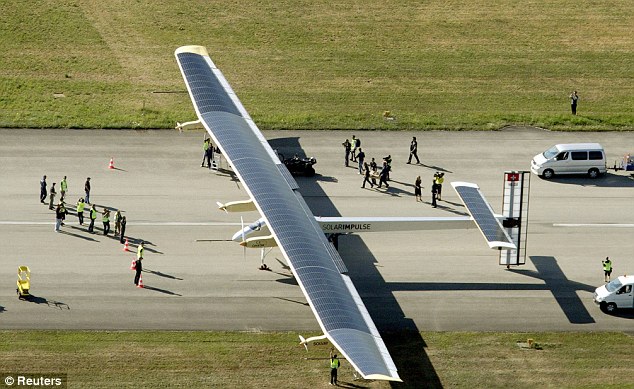
The European built solar plane Solar Impulse has completed the world’s first intercontinental flight powered by the sun with a landing in Rabat, Morocco.
Solar Impulse took off from Madrid and landed at Rabat’s International airport after a 19-hour flight.
Shortly before Swiss pilot Bertrand Piccard landed the plane in Rabat’s airport, the project co-founder and pilot Andre Borschberg said the aircraft had proved its sustainability.
“The aircraft can now fly day and night.
“It’s quite a show, it’s a technology we can trust,” he said.
An ecstatic Mr Piccard was greeted by Mr Borshberg and Mustafa Bakkoury, the head of Morocco’s solar energy agency.
The Solar Impulse project began in 2003 with a 10-year budget of €90 million ($A115 million) and has involved engineers from Swiss lift maker Schindler and research aid from Belgian chemicals group Solvay.
Just last week, the aircraft crossed the Gibraltar Strait separating Africa and Europe at one of its narrowest points.
The flight is crucial for the project’s developers because it will help in the organisation of a world tour planned for 2013.
“The flight was absolutely wonderful but I almost did not enjoy it because I told myself that Andre and I have the responsibility to bring this aircraft to Morocco,” Mr Piccard said.
The plane, which requires 12,000 solar cells, embarked on its first flight in April 2010 and completed a 26-hour flight, a record flying time for a solar powered aircraft, just three months later.
It made its first international flight last month when it completed a 13-hour flight from the western Swiss town of Payern to Brussels.
With an average flying speed of 70 kilometres an hour, Solar Impulse is not yet an immediate threat to commercial jets, which can easily travel at more than 10 times the speed.
A commercial jet flight from Madrid to Rabat can take a little more than an hour, where Solar Impulse took 19 hours.
Project leaders acknowledged it had been a major challenge to fit a slow-flying plane into the commercial air traffic system.
Morocco has ambitious plans for solar energy and will this year sign a contract for 160 megawatts to be generated using concentrated-solar technology (CSP).
It would be the first step in a national plan aimed to develop 2000-megawatts from solar energy by 2020, 38 per cent of the country’s current installed power generation capacity.