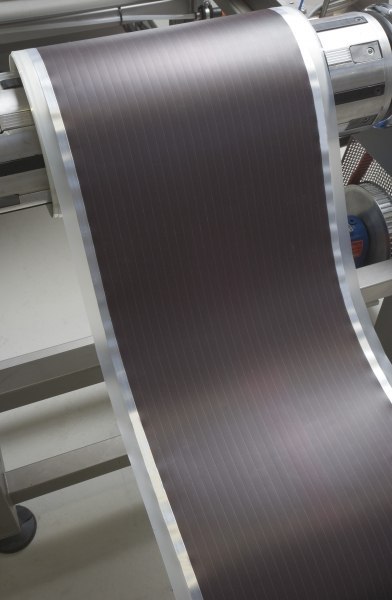
The USA’s National Renewable Energy Laboratory (NREL) has developed a product that could possibly remove one of the greatest costs associated with manufacturing silicon solar panels and lower the cost of producing solar power closer to that of coal or gas.
The NREL’s Oak Ridge National Lab has led collaborative research with the Ampulse Corporation, creating silicon wafers using a chemical deposition process onto cheap metal foil which will massively cut the cost of producing wafer-based solar cells. The silicon used in solar wafers is only about half the cost of a finished solar panel.
According to the NREL, while silicon is a relatively abundant element and current crystalline silicon technology creates high efficiency cells, it involves processes that are complex, wasteful, and energy intensive.
Before silicon can be used to convert sunlight to energy, it must first be converted into pure trichlorosilane (SiCl3) or silane (SiH4) gas. This purified gas is then converted to create a silicon feedstock at 1,000 degrees Celsius. The feedstock is melted at 1,414°C and recrystallized into crystal ingots that are finally cut into wafers.
Sometimes half of the silicon can be lost in the wafer-sawing process, which raises the cost of solar energy. The NREL estimates that 6000 potential wafers are lost during sawing a typical 2-metre bale of silicon. Also, the wafers produced are much thicker than need be. To efficiently convert sunlight into electricity, they only have to be one-tenth as thick.
NREL developed a method for growing silicon on inexpensive foil, while the Oak Ridge Lab came up with the foil substrate itself. A pilot manufacturing plant will be built by Amplulse Corp. at the NREL’s Process Development and Integration Laboratory – where solar companies test new equipment – to test whether the process will be successful on a commercial scale.
The Ampulse process “goes straight from pure silicon-containing gas to high-quality crystal silicon film,” said Brent Nelson, who runs the PDIL at NREL. “The advantage is you can make the wafer just as thin as you need it — 10 microns or less.”