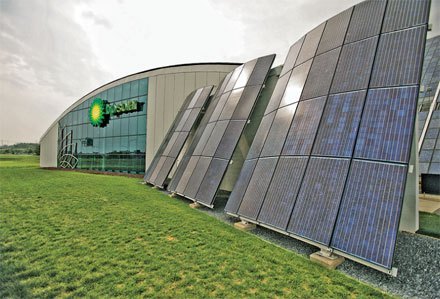
BP Solar has ceased production of solar cells at its Frederick, Md., plant and will lay off 320 of the 430 employees there. The move spells the end for BP solar cell manufacturing in the U.S.
The Frederick closure is part of a restructuring at BP Solar that will shift all photovoltaic manufacturing to its joint venture and contract manufacturing partners.
Some of the production work will move to the Xi’an, China, facility of BP SunOasis, a joint venture of BP and Xinjiang SunOasis.
BP also has a joint venture with India’s Tata and plans to ramp up capacity at the venture’s plant in Bangalore to 300 MW—about twice the size of the Frederick facility—by 2012.
BP Solar activity indicates decline in production
Last March, the company signaled that its commitment to manufacturing crystalline silicon solar cells in developed countries was waning when it closed its photovoltaic module plant in Sydney Olympic Park, in Australia, and said cell manufacturing in Madrid would cease.
At that time, BP began to phase out module assembly at the Frederick site but said high-tech manufacturing of ingots, wafers, and BP solar cells would continue. However BP has a history of withdrawing from clean energy projects.
The recent closures were necessitated by a 50% plunge in prices for solar modules since the onset of the world financial crisis in 2008, BP Solar CEO Reyad Fezzani explained during last week’s announcement. To be competitive, he said, BP must “shift to a high-quality, low-cost supply base.”
The Frederick closure is not surprising, says Johanna Schmidtke, an analyst at consulting firm Lux Research. “BP is a public version of an overall market trend—large production facilities in the West are going to joint ventures or are being outsourced” to take advantage of cheaper labor, she
Fear for green manufacturing jobs
The move does not bode well for the goal of growing “green” manufacturing jobs in the U.S., Schmidtke says. Incentives in the American Recovery & Reinvestment Act of 2009 have spurred some firms to build solar plants in the U.S.
But, she observes, “they are all small scale, just large enough to meet but not exceed government requirements for domestic production,” and they do not require many employees to operate.