
First ask: what is electricity?
Electricity is the flow of electrons through a conducting material such as the copper wiring in your home. The majority of electricity is produced at a power station by a spinning magnet to move electrons back and forth in a conducting material, known as an alternating current (AC).
Whether something is conducting or insulating electrons is to do with a property know as a materials band gap. Substances with large band gaps are generally insulators, those with smaller band gaps are semiconductors, while conductors either have very small band gaps or none. So the band gap in simple terms is the energy required to allow electrons to move freely in a solid. More technically the term “band gap” refers to the energy difference between the top of the valence band and the bottom of the conduction band. Electrons are able to jump from one band to another. However, in order for an electron to jump from a valence band to a conduction band, it requires a specific minimum amount of energy for the transition. The required energy differs with different materials. Electrons can gain enough energy to jump to the conduction band by absorbing either a phonon (heat) or a photon (light).
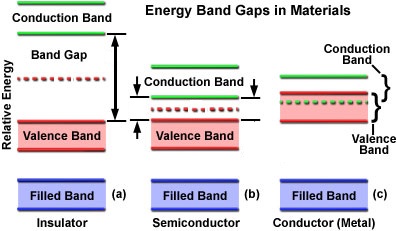
The diagram illustrates the difference between the conduction band and the non-conduction band known as the valence band. For an insulating material, similar to the material wrapped around copper wiring, the energy require for an electron to transverse the gap between the valence and conduction band is great in comparison to a conducting material such as copper.
The exciting property of a semiconductor such as silicon is that the energy required to promote an electron from the valence band to the conducting band is exactly the same as the energy of a UV (Ultra-violet) photon from the sun. A UV photon is a particle of light that emanates from the nuclear fusion of hydrogen in our sun.
How do solar panels work?
- “Solar panels may seem complicated however there’s really not much to them”
The solar panels in your home works based on this simple quantum effect, the energy of a UV photon is equal to the energy required to allow a semiconductor to conduct electricity. So the energy of the sun can power your washing machine, TV and microwave.
Interestingly if you have a microwave and solar panels you are converting electromagnetic radiation into electricity and back into electromagnetic radiation. The photons you produce in your microwave are the same energy required to rotate a molecule such as water. So when a microwave photon collides with say a water molecule it spins the molecule around its axis and in turn increases the average kinetic energy which you may know as Temperature. But that’s a different exciting quantum phenomenon… back to story.
Solar panels use a photon (a particle of light) to provide the electrons in the silicon semiconductor material to transition the band gap. The electrons are then able to move more freely throughout the crystal lattice. A modern solar panel in your home is an array of n-type and p-type silicon wafers. In simple terms N-type semiconductors have additional electron donating capacity while P-type semiconductors have electron accepting capacity. This alternating array allows the electrons to flow through the material more easily and thus producing electricity. Because this electricity is a direct current (DC), flowing in one direction, as opposed to AC, an DC/AC inverter must be connected to a home solar system.
By Australian Solar Quotes
Next: What is a solar inverter
- Checkout the latest solar power inverter brands and technologies