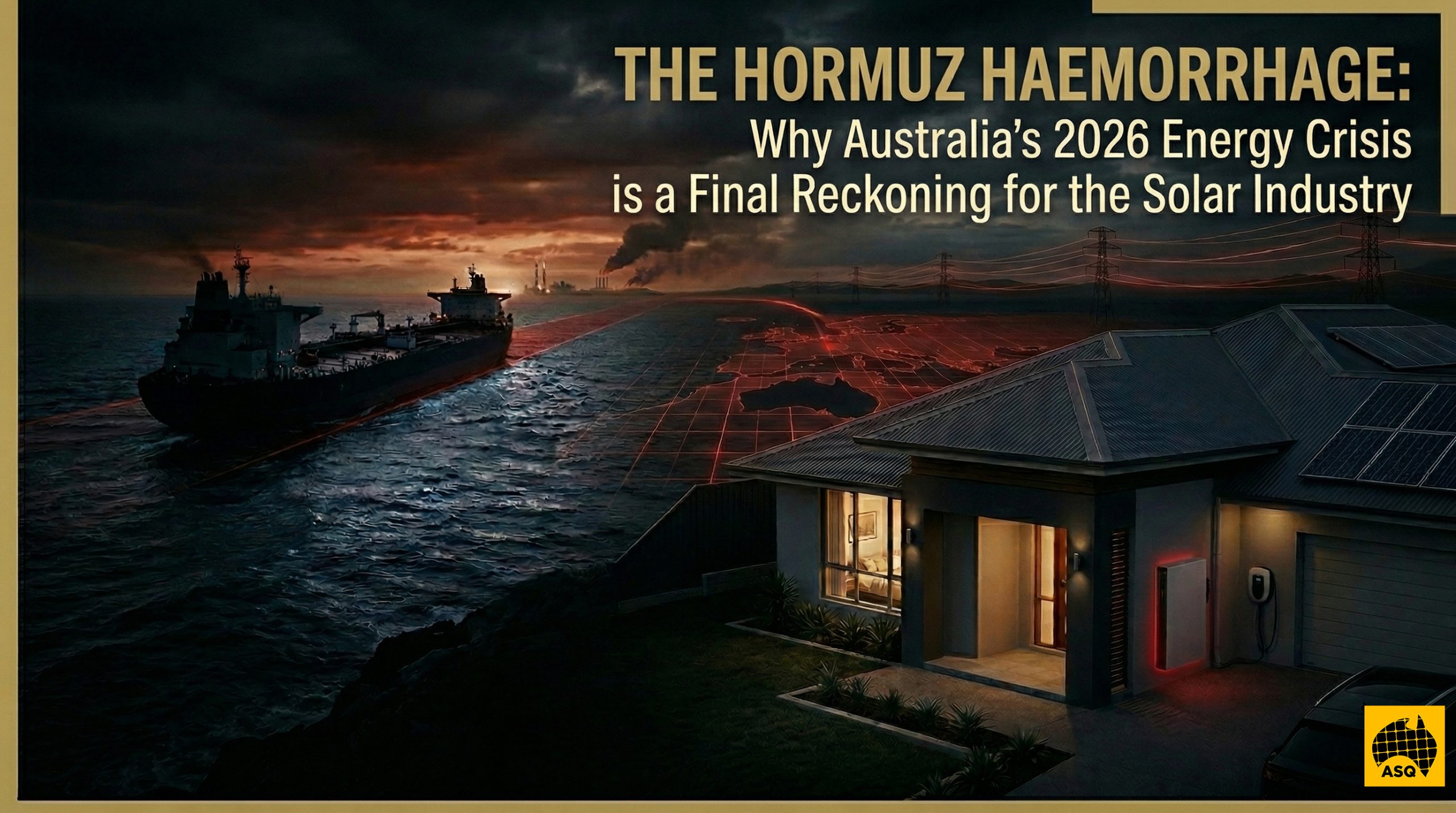
The fluorescent hum of a Brisbane showroom feels a world away from the salt-sprayed tension of the Strait of Hormuz. Yet, as March 2026 unfolds, the connection between a constricted global shipping lane and the Australian suburban switchboard has never been more visceral. In the back offices of solar dealerships, there is a mounting realisation that the “Solar Coaster” has entered a new, far more dangerous loop.
Outside, the price at the petrol bowser has ceased to be a mere grievance and has become a systemic threat. With petrol screaming toward $2.50 per litre and high-level modeling suggesting a breach of the $3.00 mark is imminent, the Australian household is no longer looking for a green alternative. They are looking for a financial bunker.
For the solar professional, the message is stark: The era of selling “payback periods” is dead. In a landscape defined by a $23,200/MWh wholesale price cap, the expiration of billion-dollar subsidies, and an RBA cash rate marching toward 4.60%, solar and storage have transitioned from discretionary upgrades to Strategic Defense Assets.
The Geopolitical Supply Shock
The conflict involving Iran is not a distant television event; it is a supply-side wrecking ball hitting the Australian economy. Because Australia remains beholden to 80–90% imported refined fuel—with emergency reserves often hovering at a precarious 30-day margin—the disruption of the Middle Eastern energy corridor acts as an immediate tax on every transaction in the country.
The “contagion” effect is already visible. As oil prices stabilise above $100 USD per barrel, the cost of freight, agriculture, and manufacturing is being passed through to the consumer with brutal efficiency. We are witnessing what economists call a “two-tier” inflationary environment: while discretionary spending on luxury goods is cratering, the cost of essentials is being propelled higher by energy volatility.
The 2026 Macro-Economic Fault Lines
| Economic Indicator | March 2026 Actual | December 2026 Projection | Systemic Impact |
|---|---|---|---|
| RBA Cash Rate | 4.10% | 4.60% | Severe Mortgage Stress |
| Headline CPI (Inflation) | 4.2% | 4.4% (Delayed Peak) | Hollowed Consumer Power |
| Wholesale Market Price Cap | $20,300/MWh | $23,200/MWh | Extreme Grid Volatility |
| Average Petrol Price | $2.26/L | $3.00/L+ | Forced EV Transition |
The Battery Rebate Cliff and the Hardship Epidemic
While the global environment drives costs up, the domestic policy floor is dropping out. The Albanese Government’s $6.8 billion energy rebate program—the very safety net that kept the headline inflation numbers artificially suppressed in 2024 and 2025—has officially expired.
The result is a “Battery Rebate Cliff” that is set to hit household budgets with a $500 annual surge starting in July 2026. This isn’t just a number on a spreadsheet; it represents 440 families every week entering formal electricity hardship. For the solar retailer, this means the average Australian family and prospective customer is now operating in a defensive crouch. They are being squeezed by a loyalty tax from retailers that averages $221 for those who haven’t switched providers, and they are increasingly skeptical of high-capital outlays.
The Rise of All-in-one Modular Batteries as Defense
To survive this climate, the solar industry must move beyond the “one-size-fits-all” sales model. As interest rates climb toward a projected 4.60% in November, liquidity is the customer’s primary concern. The solution is Energy Sovereignty, built on a foundation of hardware that can scale as the crisis intensifies.
This is where the all-in-one modularity of the more modern battery ecosystem becomes the industry’s most potent strategic tool. Unlike traditional high-voltage battery systems that require massive upfront investment, the all-in-one battery solution like the Deye AI-W series allow installers to lead with a modern modular defense.
1. Scaling with the Crisis
Instead of losing a sale to interest rate paralysis, smart battery retailers are lead-selling a base-layer 5kWh modular stack. This low-barrier entry point secures the customer now, providing immediate relief from the 24% bill surge. Because modern battery manufacturers like Sigenergy’s, Deye and BYD’s architecture is natively stackable, the installer creates a guaranteed future revenue stream: as the $3.00 petrol price eventually forces that household into an EV, additional modules can be added in minutes without a total system redesign.
2. Navigating the May 1st Rebate Tiers
The Clean Energy Regulator (CER) has introduced a tiered rebate structure that takes effect on May 1st, 2026. This is a hard deadline that will separate the professional operators from the cowboys.
Systems up to 14kWh will continue to receive the full 30% discount, but larger systems face a significant reduction in federal support. The plug-and-play nature of Deye’s BOS-G and AI-W systems allows installation crews to clear backlogs with a velocity that traditional wired systems cannot match. Shaving two hours off an installation time isn’t just a convenience; it’s the difference between a customer receiving a $4,000 rebate or missing the window entirely.
The Federal Battery Rebate “May 1st” Deadline
| System Capacity | Rebate Status (Post-May 1) | Installer Strategy |
|---|---|---|
| ≤ 14 kWh | 100% Full Discount (30%) | Primary Residential Focus |
| 14 kWh – 28 kWh | 60% of Discount Value | Urgent Backlog Clearance |
| 28 kWh – 50 kWh | 15% of Discount Value | Commercial/SME Pivot |
The EV Inevitability
The most recent data from NRMA Insurance confirms that the “Electric Transition” is no longer a slow burn—it is a wildfire. In the first two weeks of March 2026, EV insurance queries surged by 15%. Motorists have done the math: at $3.00/L, a 60-litre tank costs $180 to fill. On a solar-charged home battery, that cost effectively vanishes.
For the installer, every EV sold in Australia (now 12% of all new car sales) is a high-conviction lead for a storage upgrade. By anchoring the home with a Deye high-voltage inverter, you are providing the customer with a high-peak discharge capability that can actually handle the heavy lifting of an EV charger while simultaneously running a household during a peak grid event.
The VPP Advantage
The AEMC’s $23,200/MWh price cap is a terrifying prospect for the un-solarised, but it represents a revenue opportunity for the “Micro-Sovereign” household.
We must stop selling solar as a passive way to save. In 2026, we are selling an active participant in the National Electricity Market (NEM). Systems like the Deye BOS-G are designed for the high-cycle, high-discharge demands of Virtual Power Plants (VPPs) like Amber or Origin Loop. During a hot, low-wind evening in Adelaide or Brisbane when the grid is screaming for supply, a Deye equipped household can trade their stored energy at wholesale peaks that effectively pay for the entire system’s monthly financing in a single evening.
Lessons from the 2012 Solar Coaster
We have seen this cycle before, albeit with lower stakes. In 2012, the industry was rocked by the abrupt end of high Feed-in Tariffs. Many businesses that were built on “easy money” and volume-at-all-costs models evaporated overnight. Those who survived were the ones who focused on technical resilience and honesty.
In 2026, the enemy isn’t just a policy change; it’s a global energy war and a decade-high interest rate environment. The CER has already warned that it is “keeping a close eye” on retailers. Those who over-promise installation dates before May 1st will face the full weight of fair-trading bodies. The “herd” is being thinned once again. Only the businesses that provide Strategic Resilience over “Cheap Tech” will remain standing by 2027.
The 2026 Survival Strategy
The storm has arrived. If you are an installer or a retail business owner, your 2026 survival depends on an immediate pivot:
- Prioritise the May 1st Backlog: Audit every quote for systems over 14kWh. If you cannot guarantee a BYD or Deye stack is on the wall by April 30, you must be transparent with the customer today.
- Lead with All-in-one Modular Batteries: Stop losing sales to RBA-induced fear. Lead with a scalable Deye AI-W entry-point. Lower the hurdle to entry and build a long-term relationship for future module expansions.
- Weaponise the Petrol Price: The $3.00 bowser is your most effective closer. Every solar quote should be reframed as a “Home Refueling Station.” Connect the dots between the Strait of Hormuz and the customer’s wallet.
- Embrace the VPP Pivot: Do not install “dumb” batteries. Ensure every system is VPP-ready to help your customers arbitrage the $23,200/MWh price spikes. In 2026, a battery shouldn’t just save money; it should make it.
The era of the “solar salesman” is over. The era of the Energy Strategist has begun. The households you secure today with a Deye-centered defense will be the ones that ride out the 2026 inflation peak with their wealth intact.
Footnotes & Authoritative Sources
1. Australian Energy Market Commission (AEMC) – Update on Reliability Settings and the $23,200/MWh Market Price Cap (Feb 2026).
2. Reserve Bank of Australia (RBA) – Monetary Policy Statement: Interest Rate Projections for late 2026.
3. Clean Energy Regulator (CER) – Industry Bulletin regarding the May 1st Cheaper Home Battery Rebate transition.
4. Westpac Economics – Modeling the impact of the US-Iran conflict on Australian Fuel and Inflation Peaks.
5. Australian Energy Regulator (AER) – Q1 2026 Report on Household Energy Hardship and Payment Assistance.
6. IAG/NRMA Research – March 2026 Report on EV Insurance Inquiry Surges and Fuel Price Sensitivity.