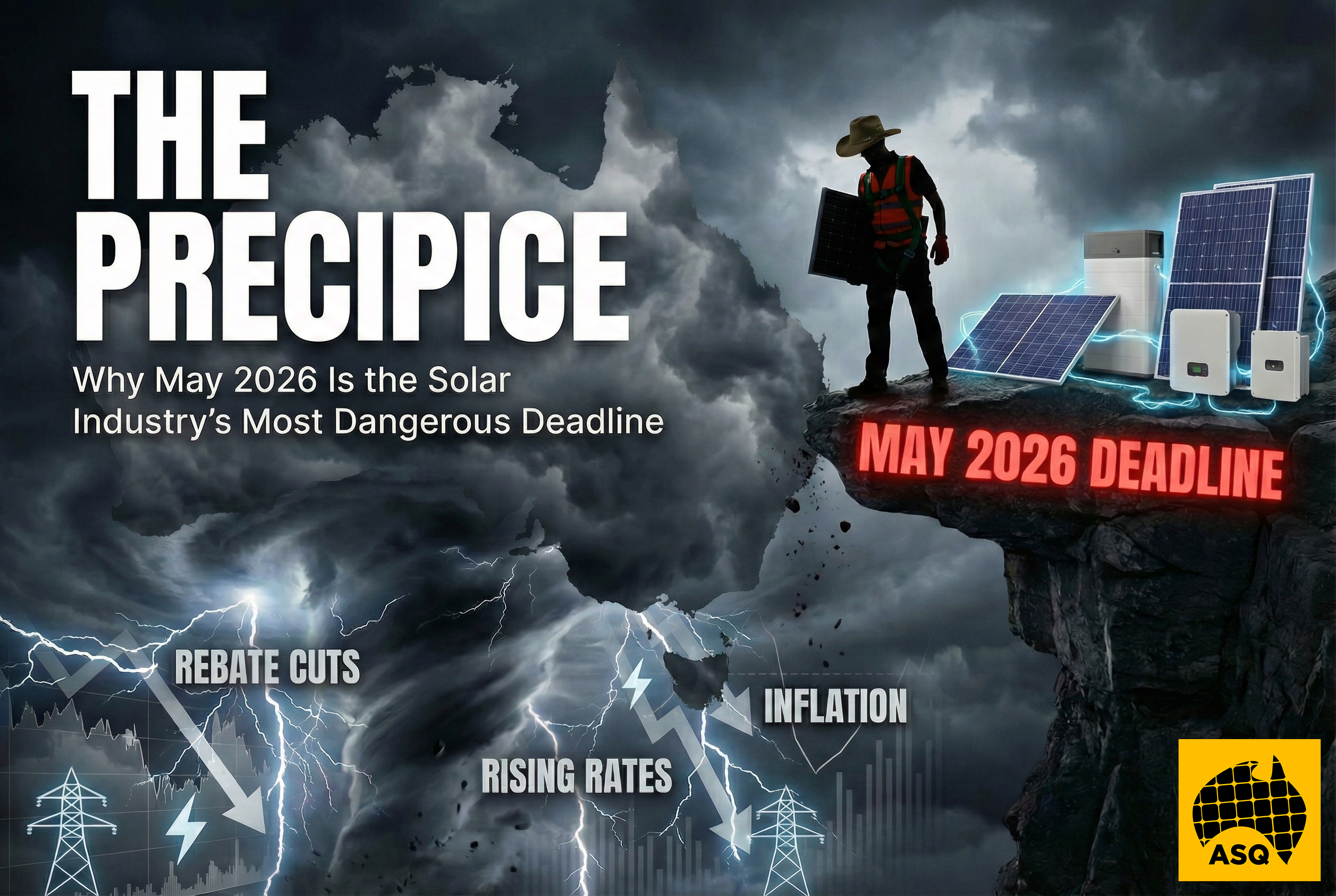
The party is still raging, but the music is about to stop. A convergence of rebate cuts, rising interest rates, and soaring inflation is brewing a perfect storm for the Australian solar sector. For installers, the next five months are not just about sales—they are about survival.
If you walk into any solar warehouse in Australia this week, the mood is likely electric. Forklifts are whirring, stock is moving, and the “Cheaper Home Batteries” program is doing exactly what the Federal Government intended: fuelling a gold rush. But for those of us who have been in this industry long enough to remember the scars of 2012, there is a distinct, unsettling chill in the summer air.
We are standing on the edge of a precipice, staring down a timeline that terminates in May 2026. It is a date that threatens to separate the resilient, quality-focused businesses from the “churn and burn” operators who are currently flooding the market with oversized storage and undersized promises.
The threat isn’t singular; it is a triple-headed hydra. We are facing a collision of policy retraction, economic tightening, and a cost-of-living crisis that will fundamentally alter the mathematics of the kitchen table sale. The window to “make hay” is closing, and when it shuts, it may not open again for a long time.
The Hangover of Good Intentions
To understand the fear that should be motivating every strategic decision you make this week, we must look at the mechanism of our current boom. The Federal Government’s recent revamp of the battery rebate—injecting an extra $4.9bn while tightening the rules—was a necessary intervention. As revealed recently, the scheme was bleeding cash, cannibalised by a market obsession with “mega-batteries” averaging 28kWh.
But the cure may prove as painful as the disease. Come May 2026, the rebate structure changes violently. For systems over 28kWh, the subsidy collapses, with the STC factor plummeting to just 15% for that tier. Even for the “sweet spot” systems under 14kWh, the rebate value will begin to erode every six months.
We have seen this movie before. In 2012, when the Solar Credits multiplier dropped from 3x to 2x, the industry held its breath. Back then, we got lucky. As reported by RenewEconomy and Solar Choice at the time, global hardware prices were in freefall, absorbing the subsidy cut and cushioning the blow for consumers. The market softened, yes—thousands of jobs were shed—but it didn’t die because the product kept getting cheaper.
Do not bet your business on a repeat performance. In 2026, we do not have the luxury of plummeting lithium prices to save us. Instead, we have the opposite: an economic environment that is actively hostile to capital expenditure.
The Economic Pincer Movement
While we obsess over STC multipliers and kilowatt-hours, the broader Australian economy is turning gears that will crush the disposable income of our target demographic.
Forecasts from Morgans and the Australian Industry Group (Ai Group) paint a grim picture for the first half of 2026. Just as our rebate drops, the “cost of living” relief is scheduled to end. Headline inflation is predicted to spike back up to 3.8%, driven largely by a rebound in electricity prices as government energy bill subsidies evaporate.
Simultaneously, the Reserve Bank of Australia is sharpening its knives. Unlike the US Federal Reserve, which is eyeing cuts, our domestic inflation stickiness has economists forecasting a cash rate hike to 4.1% by mid-2026.
The Cost of Waiting – Rebate Impact (May 2026)
| System Size | Current Rebate (Est. Pre-May 2026) |
Future Rebate (Post-May 1, 2026) |
Financial Impact |
|---|---|---|---|
| 13.5 kWh(Typical Residential) | ~$5,000 | ~$5,000 | No ChangeRebate remains at 100%. |
| 28 kWh(Current Market Avg) | ~$10,400 | ~$8,300 | -$2,100 DropTier drops to 60% >14kWh. |
| 48 kWh(Large “Off-Grid” Style) | ~$17,840 | ~$6,880 | -$10,960 CRASHTier drops to 15% >28kWh. |
Source: DCCEEW Guidelines 2025
Think about what this means for your sales conversation in June 2026. You will be sitting in the living room of a family whose mortgage repayment has just jumped again. Their grocery bill is up. Their energy bill is skyrocketing because the subsidies are gone. And you will be trying to sell them a battery that just became significantly more expensive because the government rebate has been slashed.
This is the “Valley of Death” that SunWiz warned us about in their 2012 retrospective: a soft market where leads dry up and conversion rates plummet. The customer’s borrowing power is shrinking at the exact moment our product price is rising.
The Death of the “Mega-Battery” Sales Pitch
For the last six months, the path of least resistance has been to sell big. “Get the 28kWh system,” we told them. “Soak up the rebate.” It was an easy sell because the government was paying for the excess.
That era ends in May. The new tiered rebate structure is a brutal piece of social engineering designed to kill the oversized residential battery. The government is effectively shouting that they will no longer subsidise storage that sits idle for 90% of the year.
If your business model relies on shifting huge volumes of lithium to people who don’t need it, you are walking into a trap. The “luxury” battery market is about to be decimated by the high-interest-rate reality. A $20,000+ outlay for a massive battery becomes unjustifiable when the mortgage rate hits 7% and the rebate covers a fraction of the cost.
The smart money—the survival money—must pivot immediately. We need to stop selling “capacity” and start selling “efficiency.” The future belongs to the 10-14kWh system: highly cycled, rapidly engaged, and perfectly sized to maximise the remaining 100% tier of the rebate while keeping the upfront cost palatable for a cash-strapped household.
The 2026 “Perfect Storm” Timeline
| Timeline | Government Rebate | Cost of Living (Inflation) | Mortgage Rates (RBA Cash Rate) |
|---|---|---|---|
| Late 2025 | High AvailabilityFull rebate for all sizes. | StabilisingSubsidies suppressing CPI. | StableRates holding steady. |
| Early 2026 (Jan – Mar) |
Warning PhaseLast chance for large installs. | RisingSubsidies expire; bills rebound. | TighteningRBA likely to hike. |
| MAY 2026 The Crunch |
REBATE SLASHEDLarge subsidies collapse. | PEAK PAINCPI hits ~3.8%. | PEAK RATESCash rate hits ~4.1%. |
Source: Morgans / RBA / DCCEEW
The Fear as a Filter
This impending crunch should terrify you. But it should also clarify your vision.
In a booming market, a bad installer can hide. When leads are falling from the sky, you don’t need to be efficient, you don’t need to be excellent, and you certainly don’t need to follow up. You just need to show up.
In a contracting market, mediocrity is a death sentence.
When the leads dry up in late 2026, the only thing that will keep your vans on the road is referral work. And referrals are not born from “churn and burn” sales tactics; they are born from trust, quality, and after-sales service.
This is where the fear becomes your greatest asset. Use the looming deadline of May 2026 to drive urgency in your prospective customers now, but do it with integrity. “Mr. and Mrs. Smith, we are facing a convergence of rising interest rates and falling rebates. If we install this system now, we lock in the maximum government support before the rules change, and we insulate you against the electricity price spike coming when the bill relief ends next year.”
That is not a scare tactic; that is financial advice. It is the truth.
But here is the catch: you must deliver a system that works flawlessly. Because in six months, when their neighbours are complaining about high bills and looking for a solution, that customer needs to be your billboard. If you install a cheap inverter that trips every time the grid fluctuates, or if your support line goes to voicemail, you haven’t just lost a customer—you have burned the bridge that leads to the only sales that will exist in a recessionary market.
The “Soft Landing” Fallacy
There is a dangerous complacency in parts of our industry that believes the government will step in again. “They won’t let the industry collapse,” the optimists say. “They need us for Net Zero.”
Do not count on it. The budget has expanded to $7.2bn, yes, but the rhetoric has shifted. Energy Minister Chris Bowen is talking about “responsible management” and “tapering.” The government is signalling that the training wheels are coming off. They are looking at the same inflation data we are; they know they cannot keep pumping cash into the economy without stoking the fires of inflation.
Furthermore, looking back at the 2012-2013 period, we saw that policy uncertainty alone is enough to strangle investment. The mere confusion around the changes in May might cause consumers to pause. And in a high-interest environment, a pause is as good as a “no.”
A Call to Arms for Quality
So, what is the strategy? How do we navigate the next 18 months without becoming a statistic in the next SunWiz insolvency report?
- Front-Load the Volume, but Audit the Quality Sprint now. Fill your pipeline for Q1 and Q2 2026. Use the deadline to close deals. But you must resist the temptation to cut corners to increase speed. Every screw must be tight, every cable managed, every customer educated. These installs are the seeds of your 2027 harvest.
- Right-Size the Offer Abandon the “bigger is better” mantra. Train your sales teams to become energy consultants, not just battery peddlers. detailed load analysis is no longer a “nice to have”—it is the only way to justify an ROI when the rebate shrinks. Show the customer why a 13.5kWh battery with a smart VPP connection is a better financial shield than a 30kWh brick sitting in the garage.
- The Referral Engine If you don’t have a structured, aggressive referral program, build one today. In a soft market, Customer Acquisition Cost (CAC) will soar. The only way to bypass Google and Facebook’s increasing ad costs is to turn your customer base into your sales force.
- Prepare for the Pivot Just as the industry in 2012 had to look toward commercial solar and leasing models to survive the post-multiplier slump, we must look for the next lifeline. Is it VPP participation? Is it EV charger integration? Is it commercial storage? If your entire business model is “residential retrofit batteries,” you are standing on one leg in a hurricane.
The Long View
The Australian solar industry is resilient. We have survived the end of the 44c Feed-in Tariff, the “Solar Coaster” of the RET review, and the COVID-19 lockdowns. We will survive May 2026.
But we will not all survive. The herd will be thinned. The cowboys, the cowboys, and the rebate-chasers will likely be washed away when the easy money recedes.
What remains will be a leaner, sharper, more professional industry. An industry that doesn’t rely on government handouts to make the math work, but relies on technical excellence and genuine consumer value.
The precipice is approaching. You have five months to build a bridge to the other side. Build it with quality, build it with integrity, and for the love of the sun, build it fast.
References
- Department of Climate Change, Energy, the Environment and Water
- Clean Energy Regulator
- RenewEconomy
- Reserve Bank of Australia
- SunWiz
Disclaimer: This article is an analysis of current market trends and policy announcements. It does not constitute financial advice. Industry participants are encouraged to conduct their own due diligence regarding the changes to the Cheaper Home Batteries program and broader economic forecasts.